What runs every night, and what you see in the morning.
49 detectors read the systems you already use and raise what needs a person, with a name already on it. We can never change your data, and there's no black box: every number on this page is pulled from the product itself.
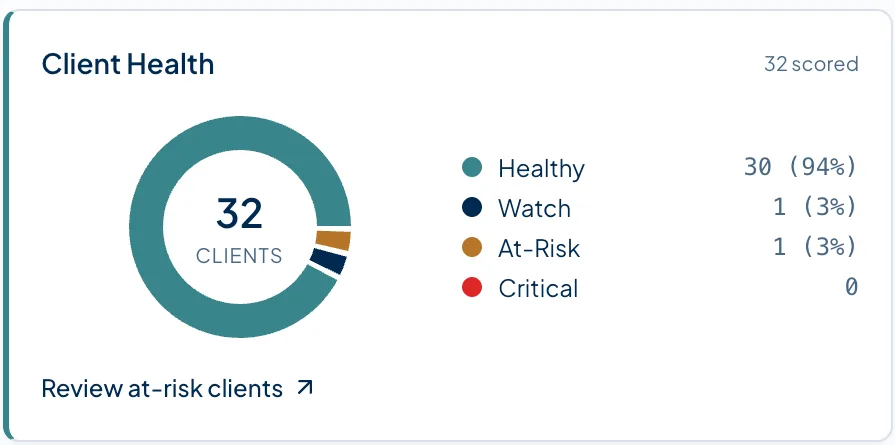
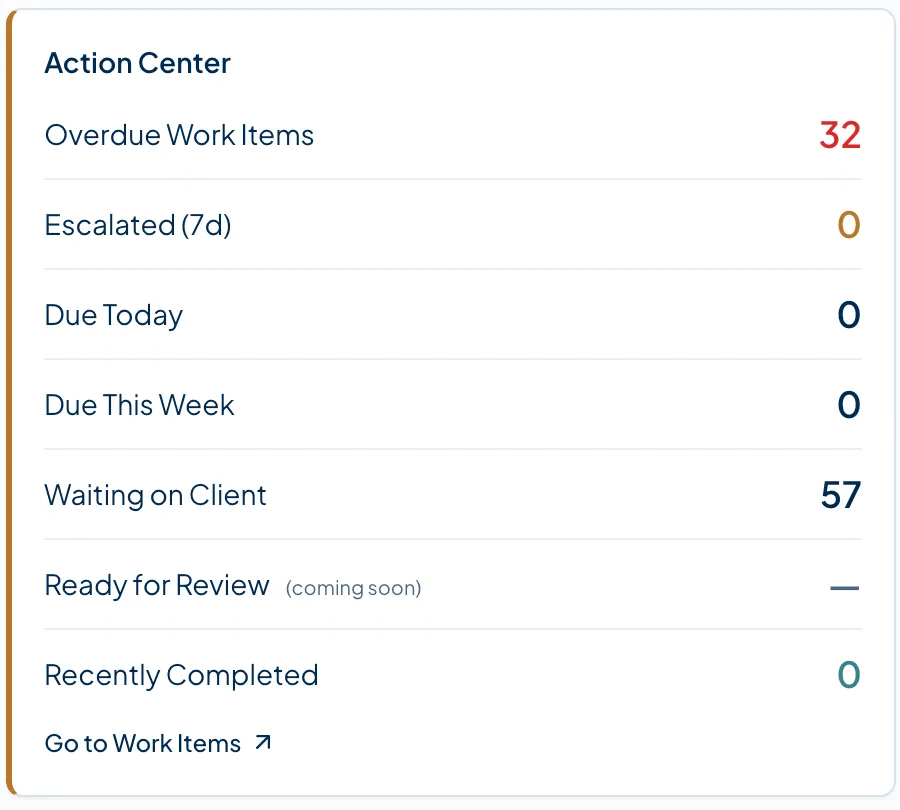
The read
It starts with a read we never turn into a write.
Every night, 360 Centric reads QuickBooks Online and Xero. Your mailbox syncs every fifteen minutes. There is no write path back to your clients' ledgers — if a number is wrong, it's wrong in QuickBooks Online or Xero, and that's where you'll fix it. What's connected, and where we stop, is on the integrations page.
Detection
49 detectors, and a count that can't quietly drift.
49
detector functions on every scan
80
distinct signal types they can raise
12
categories those signals sort into
2
of the 80 that carry a dollar figure
These come out of the product, not off a slide. An automatic check runs every time we ship, and it stops the release if the count here and the count in the product ever disagree.
Eleven of the twelve categories are active today. The twelfth, Advisory Opportunity, is set aside and still empty. We left it visible rather than rounding down to eleven.
Dollar amounts
Two signals carry money. The other 78 carry none, on purpose.
A/R Aging Risk
Source: the client's aged receivables report
medium at $5,000 · high at $25,000
Everything outside the Current bucket, added up. The two bands are shared settings, so a firm that treats $5,000 as background noise moves the line once.
Firm Invoice Overdue
Source: the firm's own invoice record
fires 3 days past due · same $5,000 / $25,000 bands
The invoiced amount, and it only fires while work is still going out the door to that client. Without that condition it would just be a past-due list, which you already own. A part-paid invoice still shows its full total, and the signal says so.
Every other signal shows nothing where a dollar amount would sit. Pricing them would take rates we don't have, so the field stays empty. A blank means we couldn't source the number. It never means zero.
Grading
A client's score is subtraction you can check.
Every client starts at 100. Each open risk signal takes points off by severity. Two highs and a medium leave that client at 55, which reads as At-Risk, and the record shows you the three rows that did it.
No model produced that, and we aren't going to add one. A health number nobody on staff can explain to the client it describes is worse than no number at all. The first time somebody asks why this client is a 55 and gets a shrug, the whole firm stops looking at the column.
Opportunities never move it. Something worth selling a client is not a reason to call the relationship unhealthy.
Points off per open risk signal
Where the score lands
The record
Every signal leaves a paper trail.
It opens
The first time a problem shows up for a client, the system logs it and stamps the time. That entry is the permanent record of this occurrence.
It reaches somebody
The signal lands in the Command Center queue right away, carrying a suggested owner already resolved from the firm's own role assignments. Staff get one digest email a day, never one email per signal.
It closes once
A person closes it, with a reason and a dollar amount if there was one. Or the condition stops being true on its own and the scanner closes it. The two endings are recorded differently: work somebody did, or a problem that solved itself.
It comes back as a new row
A condition that recurs opens a fresh occurrence rather than reopening the closed one. Restoring something a person dismissed opens a new one too.
What the thresholds are set to.
A firm sets its own dormancy months in Settings. Everything below that is a constant in the code today, and writing that down beats implying a knob exists where one doesn't.
| Threshold | Set to |
|---|---|
| Past-due receivables, medium band | $5,000 |
| Past-due receivables, high band | $25,000 |
| Grace period past an invoice due date | 3 days |
| Completed project with no agreement covering it | 14 days |
| Bank balances counted as stale | 7 days, high at 14 |
| Dormancy clock, tax and advisory work | 12 months |
| Dormancy clock, bookkeeping and payroll | 4 months |
| Warning window before a client goes dormant | 60 days |
| Before the same item can reappear in a digest | 20 hours |
| Reminders before an item stops nagging | 14 |
| Rows in one digest email | 25 |
A client who buys both bookkeeping and tax work takes the longer of the two dormancy clocks, so the four-month one never marks somebody dormant while the firm still sees them every March.
What gets measured
The record measures what you actually feel.
None of these carries a published number yet. One firm and one season is not evidence.
The missing page
Where the ROI numbers are.
The usual version of that page is arithmetic: pick an hourly rate, multiply it by hours you assume are getting lost, set the total in a big font. Nobody checks the assumptions, and everyone involved knows nobody checks them.
The record above is our answer. Every signal logs when it opened, who closed it, how, and what it was worth. One firm has been filling it since early August. At three firms and a quarter's worth of that history, the numbers go up here.
Until then: we won't show you a return we haven't measured.
Judge it on what it catches.
A demo walks the queue signal by signal, including the ones that show no dollar amount and the reason they don't. Bring the client situations you think it would miss.